# of Items: 0
Total: $.00
- CHECKOUT -

Getting Started with Warhammer 40,000
Warhammer 40,000 Miniatures Catalog

Gaming
- The Amber Prison of Tikgrix
- Choose Your Own 40K
- Revised 40K FAQs
- Revised Vehicles & Assault
- 40K Escalation Leagues
- Facts about FAQs
- Struggle for Vor'Anoth
- Tactics for 40K Flyers
- Return to Space Hulk

Painting and Modeling
- Display Trays
- Freehand Decals
- Basic Modeling
- Creature Feature
- Weapons of War

Terrain
- New 40K Tables
- Comm Bunker
- Top 10 Scenery Tips
- Basic Texturing
- $50 Scenery
- Defensive Terrain


ARMIES OF THE 40K UNIVERSE

Chaos Space Marines
Daemonhunters
Dark Eldar
Eldar
Imperial Guard
Necrons
Orks
Space Marines
Tau
Tyranids
Witch Hunters

40K SUPPLEMENTS

Chapter Approved
Cityfight
Eye of Terror

SCENERY SPECIFICATIONS
Dilapidated Shed: Warhammer
Difficulty level: Medium - Difficult
Materials Used: Balsa wood, Masonite, stones, lightweight spackling, Woodland Scenics Field Grass, Woodland Scenics Static Grass Flock, and sand.

A DILAPIDATED SHED

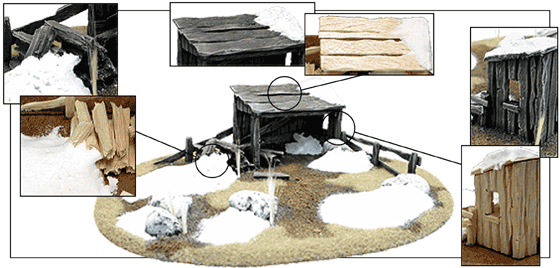
The Dilapidated Shed project was a little more ambitious than the Ruined Columns, since the shed had to be constructed from scratch. The idea was to create a building, a pile of firewood, and a length of fence, all of which would appear neglected and old. Snow would also be an important part of this piece.

To start the shed, we cut another circular base out of the Masonite. This one was much larger than the one used for the columns, as a length of fence was to extend from both sides of the shed. Once again, we sanded the edges down to a 45º angle.

After we sanded the base, we marked out the area that the shed would occupy directly on the Masonite with a permanent marker. Next, we began actual construction on the shed itself. A human-sized Warhammer miniature was used to judge the scale. We cut two walls out of a sheet of balsa wood. Both walls stood to a height of 2", and we cut a shorter side wall to create a slope for the roof to rest on. We used the leftover triangle piece for the partial opposite wall. When cutting out your walls, make sure that you think about the direction of the natural wood grain. That way, when you drybrush the balsa, the wood will look much more realistic.

Once we cut out the walls, they had to be detailed. We drew guides for the separate planks that would make up the shed. We then used a hobby knife to score the wood and cut a crooked “gap” on either side of the score mark – just deep enough to pull a thin sliver from the balsa wood, but not deep enough to cut clean through to the other side. This process was repeated for each side of each wall. To add a few details, we added a window and sill as well as a few nicks and gouges. We then glued the entire shed to the base with superglue.

To finish the details, we added the roof and a support beam for the open corner. To add a bit of stability, we cut out and glued a very thin piece of balsa along the front opening of the shed. This support beam supports the entire front section and provides an anchor for the corner support beam, which was only a thin piece cut to the proper height. We used thin pieces of balsa wood to make both sides of the roof, which were just irregular rectangles that were cut to overhang the corners of the shed slightly. We also used thin balsa to decorate the inside of the structure.


The wood pile was a simple matter of grabbing some of the thicker balsa wood and cutting one long piece off. It didn’t have to be a perfect cut, since it looks much better if the logs vary in thickness. We broke this single piece into separate logs by hand. No knife here – that would leave too smooth a cut! Ragged edges look a little more natural, and they paint up much more nicely, too. We glued the logs to the Masonite in a disorderly pile.

The fence was really simple to make. We cut four “posts” to a height of about 7/8" and then rough them up a bit with the hobby knife. We cut off sharp corners and gouged the posts. Then, we glued the posts down to the Masonite at regular intervals with a dab of superglue. We cut the slats from the thin balsa and glued them in place. To maintain the appearance of neglect, we glued the slats at irregular angles to create the look of a missing nail or two.

The actual man-made structure was finished. We could now begin work on the “natural” elements. Again, we glued stones to the base with an ample amount of superglue. We made the snowdrifts from spackling. We spread this quick-drying compound on the Masonite and smoothed the edges into slopes that met the board. To give the impression that the drifts were formed by wind blowing from the same direction, we shaped the spackling slopes to lay up against the boulders and the building at the same angle. Little details like the direction of these snow drifts make scenery much more realistic and believable. We left the spackling overnight to dry completely.

The following day, we added sand with more wood glue. The only thing left to do was to finish the project with a few coats of paint. We primed the entire piece of scenery black. First, we drybrushed the shed with a dark brown, followed by varying shades of grey. We did this because it was hard to imagine the shed retaining its brown color after weathering storm, sun, and snow. Then, we painted the ground in browns to suggest sodden dirt. We added Gloss Varnish around the piles of snow to suggest meltwater or mud. We painted the rocks light grey so they would stand out against the soil, the white of the snowdrifts, and the stark grey shed. We painted the drifts first with Ghostly Grey and then drybrushed with Skull White. Lastly, we attached Static Grass and a few tufts of Field Grass to the base in patches with wood glue.

While more time consuming than the Ruined Columns, this piece is a perfect start to building your own small Empire village.


Ruined Columns
Dilapidated Shed
Tau Escape Pod
Ruined Wall

INTRODUCTION INDEXSUMMARY

Home | About Games Workshop | Job Announcements | Contact Us | Introduction Tour
GW Worldwide | Help | Shopping and Online Store | Investor Relations | Site Map
Privacy Policy | Terms of Use
Copyright Games Workshop Ltd 2000-2005