|
|
– Thick
plasticard or Masonite hardboard
–
Thick card or plasticard
– Sheet
of 3/8" thick foamcore
– Miscellaneous cool bitz
for decoration
– Coarse and fine sand
– White (PVA) glue and super
glue
– A large, old brush and
a paper cup
– Pencil and steel ruler
– Clippers, hobby knife,
and cutting surface
– Foamcore cutter (optional)
|
|
When all your outer defenses fail, it's always
good to have some great cover to duck behind when
the opposition begins to get within firing range.
Fortifications like thick walls are key factors
in a rock-solid defense. Behind a few feet of
cover, you can calmly formulate a new plan for
how you're going to get out of this mess! Making
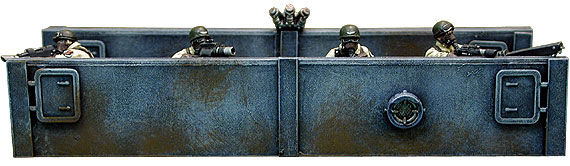
a few fortified walls is really not too hard.
After just a couple easy steps, you too can have
cover like the two walls shown stacked behind
each other in the picture above.
Before starting, you'll
need to gather some supplies and tools to build
your walls. Don't worry if you are missing a
few things, because you can always try to improvise
with the materials you have on hand.
|
|
|
|
|
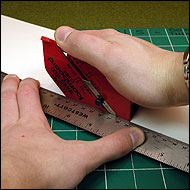
Gather up some
of your foamcore and a cutting instrument.
If you have the luxury of owning a foamcore
cutter, then these steps will go by
a bit easier. A foamcore cutter or mat
cutter is basically a sharp blade fitted
into a frame that produces excellent
90- or 45-degree cuts through foamcore.
This precision helps out quite a bit
when you piece together our creation
in the next step. However, this tool
is not entirely necessary. You can achieve
a good, clean cut through foamcore with
a sharp blade and careful, precise cuts.
Like always, watch your fingers and
if you are too young to use cutting
tools like these, please ask your folks
for help.
You can make each
defensive wall whatever length you choose
– just be sure to stick to one
universal height for each of your sections.
In our example above, we made a pair
of 6"-long, 1"-high wall sections.
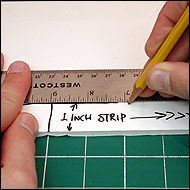
First, cut out the wall section itself.
Measure out a 12"x1" rectangle.
You'll need a sharp pencil tip to make
an accurate line, so keep a sharpener
handy if you plan to do more than just
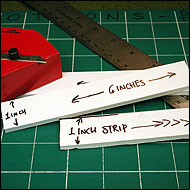
a few wall sections. Now, cut this rectangle
out of the foamcore. Next, cut this
12" piece in half to make two equal
6"x1" rectangles. Take your
time and make each cut carefully. If
you rush through these steps, your walls
will not fit together right, and you'll
just have to start over anyway. Do it
right the first time! Set these rectangles
aside and move on to the tricky part
of cutting out the supports.
|
|
|
|
|
With the pencil,
draw out another rectangle in the middle
of some foamcore, this time at 6"x1"(don't
cut just yet). The length will vary
depending on how many supports you need.
The longer the rectangle, the more supports
you'll require. Now, starting at one
end of the rectangle, mark off 1"
lines along the length of the rectangle
to create 1" squares. Keep in mind
that each square will yield two supports.
The two 6"-long wall sections in
our example each require three supports,
so we drew three squares.
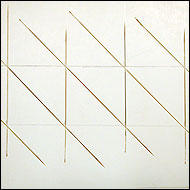
You should now
have a long rectangle with a bunch of
lines running through it in front of
you. Take up your cutting tools and
begin cutting diagonally across each
square you drew. You should not cut
anything free of the foamcore just yet,
and for good reason. Making small cuts
in foamcore is very difficult if there
isn't much material to grip and hold
everything steady. Thus, try to keep
everything together on a big sheet until
the final cuts.
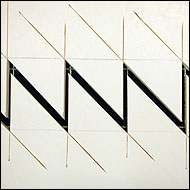
Next, make vertical
cuts along parallel edges of each square
like the picture above. When you are
finished with these two types of cuts,
you'll be able to separate the foamcore
into two halves that sorta look like
jagged teeth. All that's left now is
to free the triangular "teeth"
by cutting along the length of the original
rectangle.
During this whole
process, you really need to be careful
and make your cuts count. Accuracy is
crucial, as you want all the pieces
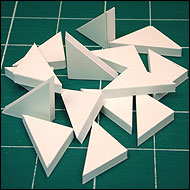
to line up nicely! Gather up your pile
of lovely little support triangles and
put them aside – it's time to
cut out the final bits.
|
|
|
|
|
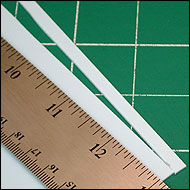
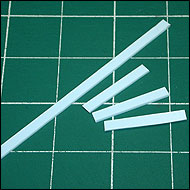
Dig up a sheet
of plasticard or thin cardboard (a cereal
box will do). Measure out a 3/8"x10"
rectangle along one edge. The length
of this strip will vary depending upon
how long your wall is and how many support
triangles it contains. For our 6"
wall example, about 10" of card
is right. Carefully cut out this thin
strip. You will use this material to
cover any bare foamcore and to serve
as cosmetic detail. Continue cutting
out strips for each defensive wall you
wish to make.
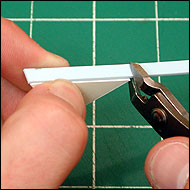
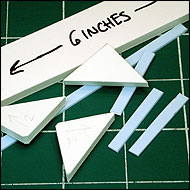
Now, cut each
strip into appropriately sized bits
that you will glue along the walls.
To size each bit accordingly, hold your
3/8" strip along the top edge of
a wall section to determine how long
it should be (in our example, 6").
Cut the strip at this length. Do the
same for each triangular support along
its long edge, which should be a little
over 1" per support.
|
|
|
|
|
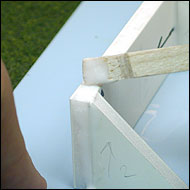
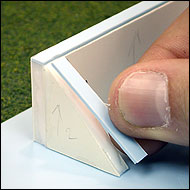
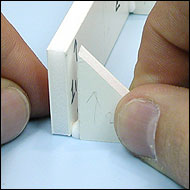
Separate out
a wall section and three triangle supports
from your pile of cut-up bits. Place
the wall on a flat surface and try lining
up the support triangles against the
wall. Test out different pieces and
flip the triangles around until you
have a set that works together to form
a wall with three supports. If you are
doing a bunch of defensive walls at
once, it's a good idea to label each
set of bits that work well together
so that you know which ones go with
which wall when it comes time to glue
this stuff together.
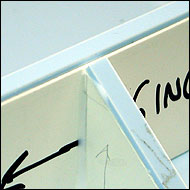
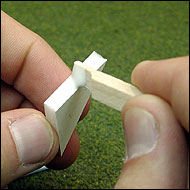
Grab your white
glue and spread some along the edge
of a support triangle. Affix each support
triangle to the wall using firm pressure
and the power of glue. Clean up any
excess glue along the edges. Repeat
this process for each wall section.
It is a good idea
to place your still-drying structures
on a piece of paper or extra plasticard.
This precaution is necessary as the
white glue will seep down as it dries.
Be sure to move the structure occasionally,
as you don't want it to permanently
attach itself to whatever it's resting
on! Allow the glue to set before moving
on to covering the foamcore edges.
|
|
|
|
|
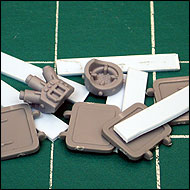
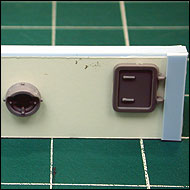
Gather up some
interesting bitz from your bitz box
to decorate the wall. If you don't have
a vast collection from which to draw,
try cutting up interesting designs and
shapes from plasticard or thin card
and affix them to the front of each
wall. If you want to try a patchwork-metal
look, cut pieces of plasticard or thin
card into rectangles and squares. You
can glue these pieces into place all
along the front of the wall in a haphazard
or orderly fashion. You can also try
to add a battle-worn look by drilling
a few bolter holes in a row along a
wall where you see fit. Finally, you
can just leave well enough alone and
move on to painting the walls with no
extra bitz at all.
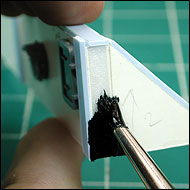
Before you undercoat
your terrain with spray primer, be sure
to hand paint all exposed foamcore with
some Chaos Black paint. Only then can
you safely spray the foamcore and paint
the piece.
|
|
|
|

|
|