|
 |
– Thick
plasticard or Masonite hardboard
– 1/4" balsa wood sticks
– 22-gauge picture-hanging
wire
– 26-gauge floral wire
– Epoxy modeling putty (green
stuff)
– Miscellaneous cool bitz
for wreckage
– Coarse and fine sand mixed
– White (PVA) glue and super
glue
– A large, old brush and a paper
cup
– Pencil and steel ruler
– Clippers, hobby knife,
and cutting surface |
|
Breaking through razor wire is an unpleasant experience
that forces you to make your way through sharpened
metal wiring while ducking incoming fire. Razor
wire is invaluable as a defensive measure it
denies the enemy easy movement. In short, it buys
a defender valuable seconds to pump a few more
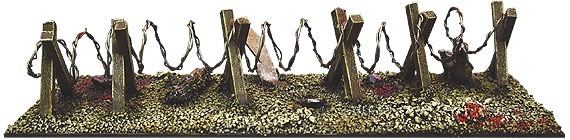
rounds into the enemy before close combat begins! We made the stretch of razor wire
above with common materials available
at any craft store along with some various bitz
that you'll likely have in your bitz box. With a little time and effort, you too will have
plenty of lovely razor wire.
Before starting, you'll
need to gather some supplies and tools to build
your razor wire. Don't worry if you are missing
a few things, because you can always try to
improvise.
|
|
 |
 |
 |
First, you'll
need to cut out a 6" rectangular
section from your base material. The
base can be any width, but 2" should
do nicely. Since you can have up to
six razor wire sections in a scenario,
cut out six bases – you might
as well make 'em all right now.
Razor
wire is supported by a bunch of wooden struts that keep the wire in
place on the battlefield – time to make these crossbeams. Measure and
cut out about a 1.25" length of the balsa stick. Use this length as
your template and cut out another of equal length (you don't have to be
too precise). Repeat this until you have 12 separate 1.25" sticks.
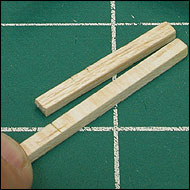
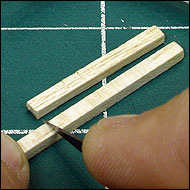
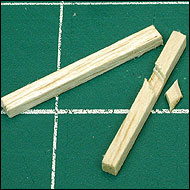
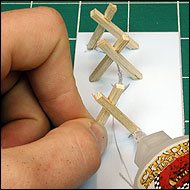
Now, grab two
small sticks. Make two diagonal, parallel
slashes across the width of a single
stick an inch up from the base. Make
the cuts through about half the depth
of the wood, but not completely through
the stick.
|
|
 |
 |
 |
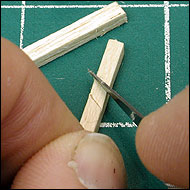
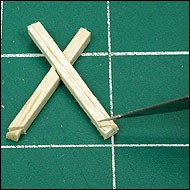
Next, slide
your blade into one of the slashes and
carve out the wood chunk between them.
You should now have a notch into which
the other stick can fit snugly. Place
a dab of white glue in the notch and
insert the other stick to make your
crossbeam.
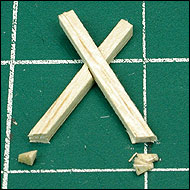
Once you've made
six supports from the 12 sticks and
glued them together, it is time to cut
them so they'll stand upright and level
(sort of). All you have to do is cut
a triangular bit off the bottom to make
the crossbeam sit level. Check out the
images above to see how to do it. Repeat
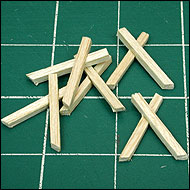
this procedure until you have a healthy
pile of wooden "X" supports
ready to be affixed to the base.
|
|
 |
 |
 |
Now, it's time
place all the supports on the base.
Although it seems like a good idea to
just plain glue 'em down, it's not.
Sure, we'll be applying glue, but more
support is necessary. Enter epoxy putty.
Green stuff along with super glue makes
for an extremely tough bond that will
help keep your crossbeams from breaking
off during gameplay.
First, plot out
how you want the supports arranged on
the base. We drew a curved line on our
plasticard base. Once you've decided
on the general layout, place a blob
of super glue on the foot of each crossbeam
and stick it in place on the base. Do
this for each "X" and wait
for the glue to dry. While you wait,
grab the epoxy putty and mix up a fresh
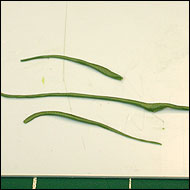
batch. Roll it into a thin line with
the thickness of a paper clip.
|
|
 |
 |
 |
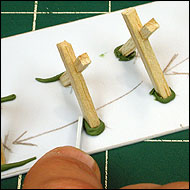
| Now, assuming the glue is dry, break
off smaller sections of your line of putty
and place them against each and every
foot of an "X" that meets the
base. Use an extra bit of plasticard,
a paperclip, or a sculpting tool to wrap
the thin line of putty around each foot.
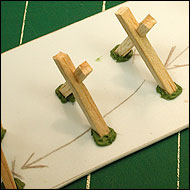
Once each foot is encircled, use your
sculpting tool and press in the green
stuff to completely seal each foot. While
the putty dries, add super glue to the
green stuff to form the super bond we
mentioned before.
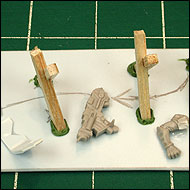
Now is the time
to place battlefield rubble onto your
bases before we cover it with sand .
Use old guns, arms, weapon bitz, cut
up plasticard, vehicle bitz, and any
other detritus you have on hand. Once
these bitz dry, texture the base with
a coat of white glue followed by a mix
of fine and coarse sand. Paint the razor
wire patch as you see fit and set it
aside for now.
|
|
 |
 |
 |
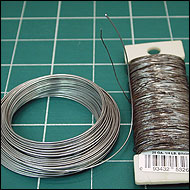
Gather up your
22-gauge wire (thick), 26-gauge wire
(thin), clippers, and super glue. You
can find both types of wire at your
local hardware or craft store.
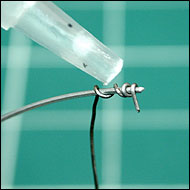
First,
cut off a 22" length of the 22-guage
wire. Straighten it out so it'll be
a bit easier to work with. Now, wrap
the thinner, 26-gauge wire around one
end of the 22-gauge wire. Make a sort
of knot by going around and around the
wire a couple of times. Then, place
a drop of super glue on this knotted
area to secure it. This glued knot will
make the next steps much, much easier.
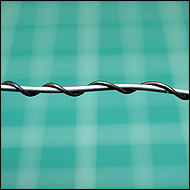
With the glue
dry, begin twisting the 26-gauge wire
(while it is still on the spool) around
the thicker, 22-gauge wire in a helix
pattern. Continue going round and round
until you get to the end of the 22-gauge
wire. Try and keep your coils fairly
close together. Once you've wrapped
the thinner wire all the way to the
end of the thicker 22 gauge wire, wrap
a knot with the wiring and seal it with
some super glue like you did when you
started wrapping.
|
|
 |
 |
 |
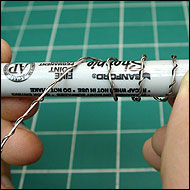
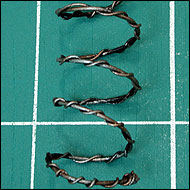
Dig
up a thick pen, marker, or other cylindrical object that's about 1/2"
thick. Wrap your length of twisted wiring around the object until you
can't wrap any more and then slide it off. This process will give you a
good bundle of curved razor wire. Place this aside and repeat for any
other razor wire patches you plan on making. Quickly paint the razor
wire before moving on.
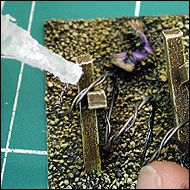
Attach one end
of the razor wire to the first crossbeam
in the line. Try to place this first
point of contact in the area where the
two sticks meet in the center of the
"X". Use a single dot of super
glue and patiently wait for it to dry.
Since the wire is probably coiled together
tightly, stretch out the razor wire
a bit so that it is as long as the base.
Carefully fit
the razor wire to the center of each
support crossbeam. It's a good idea
to lay the entire length of wire across
the base before you begin gluing. This
way, if there is a problem further down
the line, you can correct it now. Don't
be afraid to bend the wire a bit if
necessary. In fact, you will have to
do this in a few spots for the wire
to sit nicely. Once the razor wire is
strung to your liking, finish with a
drop of super glue at each point that
the wire meets with the support struts.
|
|
|
|

|
|